
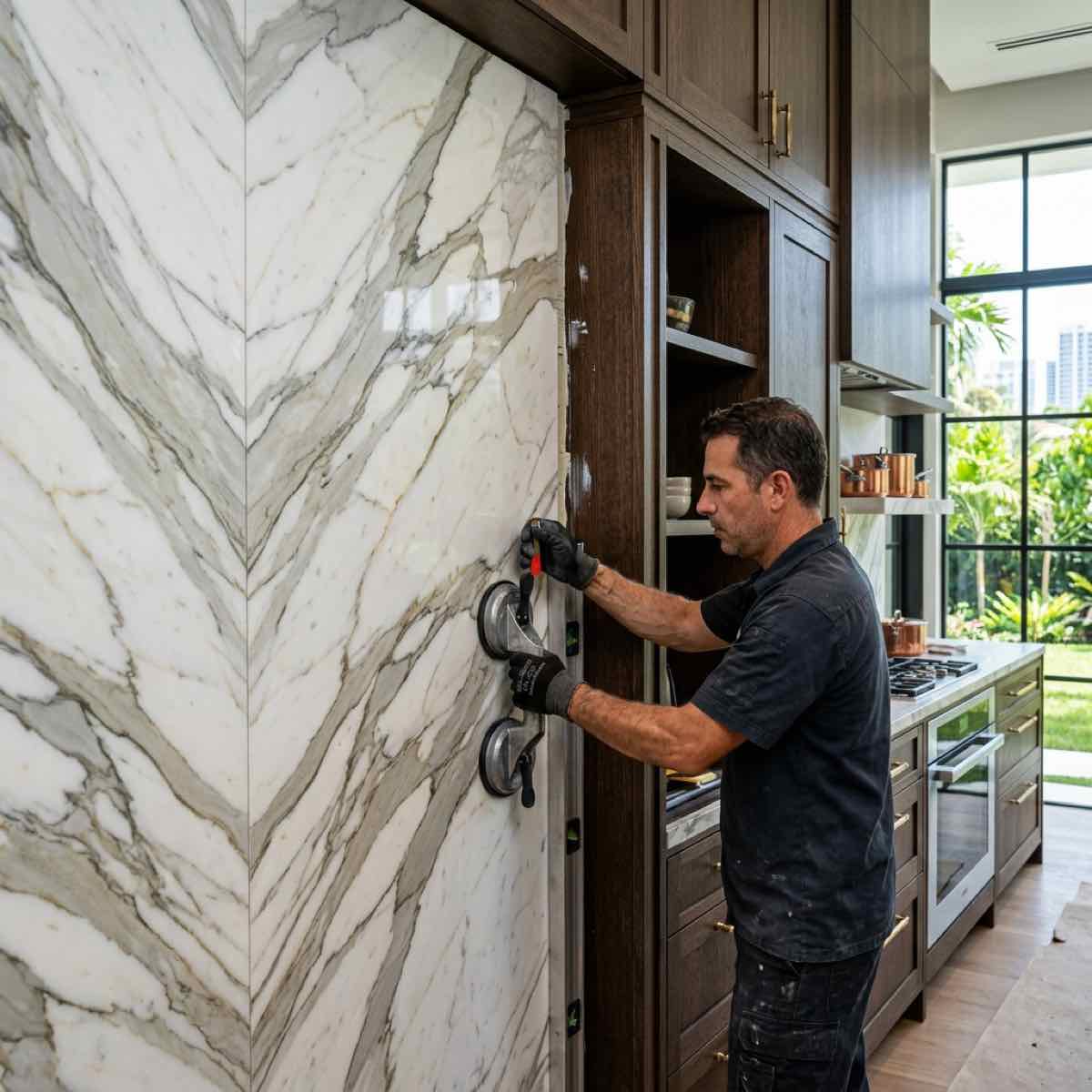
Behind every seamless kitchen hides extraordinary complexity. See how our legacy artisans fuse traditional woodworking methods with hyper-modern bookmatched stone.
Walk into any Moros kitchen and the first thing you notice is what you don't notice — no visible fasteners, no misaligned grain, no seams fighting for attention. What looks effortless is the product of hundreds of hours of shop drawings, dry-assembly mockups, and the kind of obsessive calibration that separates furniture-grade millwork from production cabinetry.
The Shop Before the Site
Every custom cabinet and architectural detail in a Moros project begins in our woodworking facility, not on site. We build complete modules — full-height pantry runs, island cores, integrated appliance panels — and test-fit them in the shop before a single piece is loaded on the truck. This means installation day is a precision placement operation, not a field problem-solving session.
Bookmatched Stone: The Mathematics of Beauty
When a client requests bookmatched marble for a kitchen backsplash or island waterfall, the work begins at the slab yard. We photograph every slab, number them sequentially, and use digital layout tools to plan the butterfly fold before any cutting begins. The veining must mirror itself perfectly at the join — an effect so precise that even a few millimeters of misalignment destrys the illusion. Our stone team works directly with our millwork team to ensure substrates are furred to the exact thickness required to align surface planes with adjacent cabinetry.
Finishing as a Discipline
The final finish coat is where most millwork projects succeed or fail. We apply a five-step hand-sanding and sealing process on all painted cabinetry — grain raising, primer, block sanding, two topcoats, and a final scuff coat — executed in a dust-controlled environment. The result is a depth of finish that responds to light the way a lacquered grand piano does, not the way a painted box does.
Why It Matters
Clients sometimes ask why custom millwork costs what it does. The honest answer is time and talent. You are paying for a craftsman who has spent fifteen years learning how wood moves with humidity, how grain orientation affects visible texture, and how to build a mitered corner that will still be tight in twenty years. That knowledge is not available by the linear foot.